
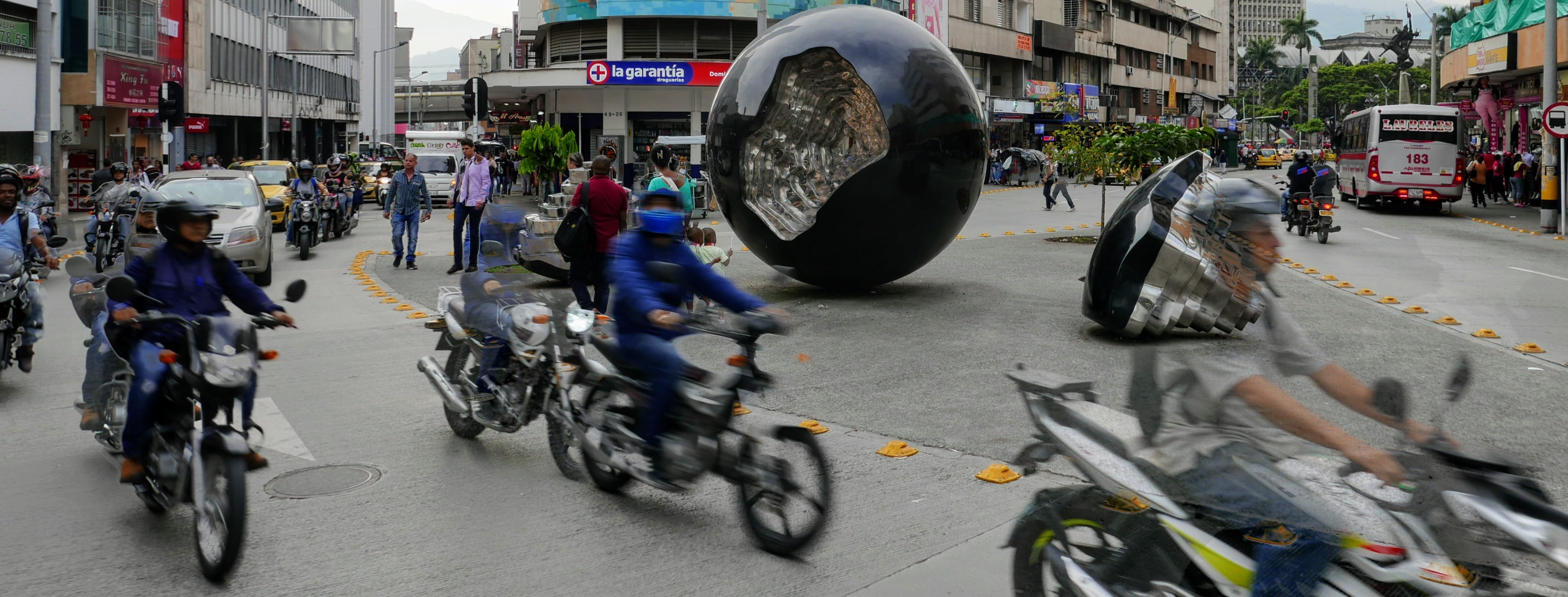
The other night I pulled up to a red light. It was late, probably close to midnight. On the other street, the one on the orthogonal axis, I mean the cross street, there was only one car waiting for the light, or I think so, I wasn’t really paying attention. But I do remember that when it started moving, it proceeded slowly across the intersection. Tentatively. Grudgingly. I watched it cross in front of me. The driver was still looking at her phone.
Afterwards, on that street, the one with the green light, there was no more traffic. Nobody.
Another car joined me. I looked over at it and figured it was probably an Uber or something because, well, although it wasn’t marked as a taxi, the driver was in the front seat on the left, and the passenger was in the back seat on the right. Anyway, it seemed that the driver was taking advantage of this moment, this pause, to check whatever was going on in his electronic devices. He had three or four different screens to check, from what I could tell.
Another car pulled up behind it.
And then two motos came up behind me. In my mirror, I saw two helmets looking at each other. I could see, or maybe I just assumed, that they were tempted for a moment to slip between the cars and run the light. To do things the old way. The way everyone thought it would always be.
Until a year ago.
The old way: when the law, social expectations, conformity, obedience—whatever you want to call that thing—just a year ago, it weighed far less on motos than on other vehicles. They were the agents of a kind of anarchic efficiency, if by efficiency you mean the exploitation of every part of the roadway, every sliver of space, every gap between larger vehicles. Damned and bold, they took their lives and their safety in their own hands, confident that the risks of breaking the rules mattered less than the five or ten minutes that could be saved right now. They were confident, too, or they must have been (it’s not like I interviewed them or anything—I just watched them through the windshield and through the closed windows of doors with automatic locks) that if something went wrong, if some SUV driver, say, got distracted and made a mistake, well it was obvious that someone else would pay the price for the communal gamble, the gigantic bet being placed by every moto in town: the bet that getting there soon always mattered more than getting there safely. You could see it in their faces, the certainty that they wouldn’t be the one to go down, the one who touched the pavement—it would be someone else, a rookie, maybe, or someone with slower reflexes.
But that night, in my mirror, I saw a shake of a helmeted head. A denial of risk. A cautious refusal. I couldn’t see the moto itself, but I figured it was a new one, all electric, fully integrated into The System, and the beneficiary thereby of dozens of privileges, not least of which was the ultra-fast lane in the new tunnels. Privileges that depended, of course, on following the rules. On continuing to follow the rules. On always following the rules.
And that night it turned out to be justified—that compliance, that passive obedience, that rejection of anarchy—because at that very moment the light changed, and we all went forward. When I got home, I logged into The System and checked my travel log (I’m that kind of nerd). The default duration of that red light was 50 seconds. In that sequence, it had lasted only 42.
The System had seen us waiting. It worked.
This imaginary incident, from the near future, exists in conversation with the following:
https://en.wikipedia.org/wiki/Governmentality